
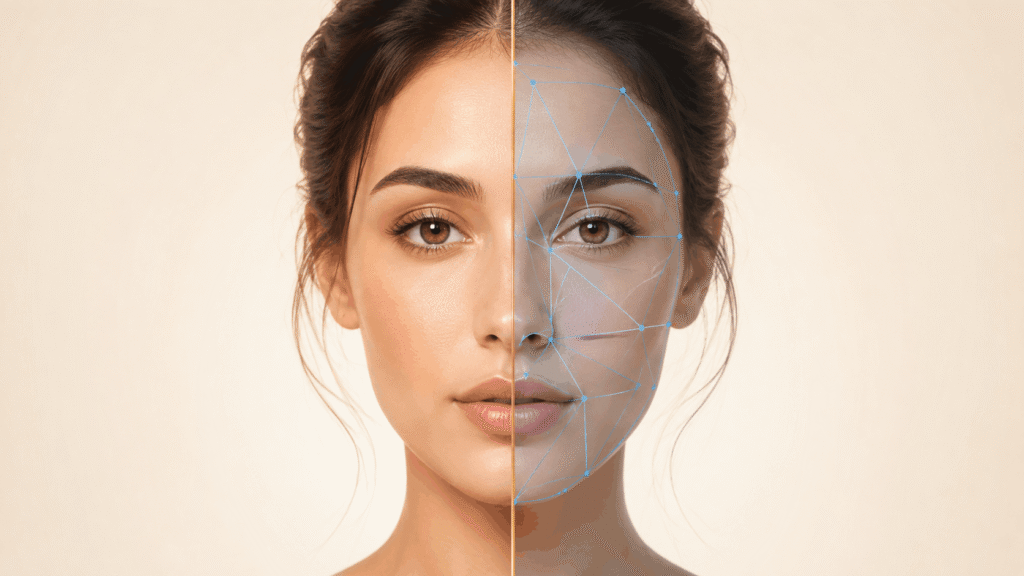
What Is Facial Symmetry?
Facial symmetry refers to how closely the left and right halves of a face mirror each other when divided by a vertical line through the center. A perfectly symmetrical face would look identical on both sides — but no human face achieves this. Every person’s face has some degree of natural asymmetry, typically small, and this is completely normal.
The study of facial symmetry sits at the intersection of evolutionary biology, psychology, genetics, and medicine. It has been researched extensively because of its consistent relationship with health perception and attractiveness across cultures — making it one of the most universally studied aspects of human facial appearance.
The Science Behind Facial Symmetry
Facial symmetry develops during embryonic growth and early childhood. The left and right sides of the face develop from the same genetic blueprint but are influenced by environmental factors, nutrition, hormonal exposure, disease, and random developmental variation throughout the growth process.
The scientific term for symmetry that results from mirroring around a central axis is bilateral symmetry. For faces, bilateral symmetry refers specifically to left-right mirroring. The degree of deviation from perfect bilateral symmetry is called fluctuating asymmetry — small, random differences between the two sides that accumulate during development.
Research in evolutionary biology has found that fluctuating asymmetry is inversely correlated with developmental stability. Individuals who develop in optimal conditions with good nutrition, low stress, and no significant disease tend to have lower fluctuating asymmetry than those who experience developmental stressors. This is why facial symmetry is thought to signal genetic health and developmental quality to observers.
What Causes Facial Asymmetry?
Every human face has asymmetry from multiple sources that act together throughout life.
Genetics plays the primary role. The genes that control facial bone development, muscle positioning, and soft tissue distribution are not perfectly bilaterally symmetrical in their expression. This means that even identical twins — who share the same genetic code — develop measurably different facial asymmetry patterns.
Developmental stressors during growth reduce symmetry. Poor nutrition during childhood, illness, environmental toxins, and psychological stress all create systemic physiological stress that interferes with the precise bilateral development of facial structures. This is the basis of the hypothesis that symmetry signals developmental health.
Muscle use patterns create soft tissue asymmetry over time. Most people habitually chew on one preferred side, sleep on one preferred side of the face, and use facial muscles asymmetrically during expression. Over years and decades these habitual patterns develop the muscles on one side differently from the other, creating visible soft tissue asymmetry even when the underlying bone structure is relatively balanced.
Dental and jaw alignment affects the lower face significantly. An uneven bite, a crossbite, or misaligned teeth cause the jaw to shift subtly during chewing and resting. Over time this shift affects the position of the lower jaw and can create or increase jaw and chin asymmetry.
Injuries and medical conditions can cause sudden asymmetry. Bell’s palsy, temporomandibular joint disorders, previous facial fractures, and certain skin conditions can all create or increase facial asymmetry.
Aging redistributes facial fat asymmetrically. Even faces that appear relatively symmetrical in youth often develop more noticeable asymmetry with age as fat migrates downward and volume loss occurs at different rates on each side.
Facial Symmetry and Attractiveness — What Research Shows
The relationship between facial symmetry and attractiveness is one of the most replicated findings in facial perception research. Studies conducted across many different cultures, using multiple methodologies, have consistently found that more symmetrical faces are rated as more attractive than less symmetrical ones.
The first major research on this topic emerged in the 1990s when psychologists began systematically manipulating facial symmetry in photographs and measuring attractiveness ratings. Faces with increased symmetry were consistently rated as more attractive, healthier, and more dominant than original photos.
Cross-cultural studies have found that the preference for symmetrical faces appears across dramatically different cultures — including isolated indigenous populations with no exposure to Western media — suggesting that the preference is not culturally learned but reflects a universal cognitive response that evolved because symmetry correlates with genetic quality.
Symmetry preference also appears in studies of infants. Babies as young as two months prefer to look at more symmetrical faces, indicating that the preference develops very early and does not depend on cultural exposure.
However the relationship between symmetry and attractiveness is not absolute. Research has also found that perfectly symmetrical computer-generated faces — created by exactly mirroring one side of a face — are sometimes rated as less attractive than the original asymmetrical face. This suggests that natural slight asymmetry may be preferable to mathematical perfection, possibly because perfectly symmetrical faces look unnatural or eerie to observers.
The current scientific consensus is that symmetry is one of several important factors in facial attractiveness — alongside other cues including averageness of features, skin quality, sexual dimorphism, and expression — and that the relationship is probabilistic rather than deterministic.
How Is Facial Symmetry Measured?
Researchers and AI tools measure facial symmetry using geometric analysis of facial landmark positions. The process involves three main steps.
First, facial landmarks are detected. Traditional research used physical measurements with calipers. Modern tools use computer vision to detect dozens of specific points on the face — the corners of the eyes, the edges of the mouth, the tip of the nose, the jaw corners, and many other anatomically defined positions. Our Face Symmetry Analyzer uses a 68-landmark model to map your face.
Second, the facial midline is established. The midline is the vertical axis running from the top of the forehead through the nose tip to the chin. All bilateral measurements are made relative to this central axis.
Third, bilateral distances are compared. For each paired feature — left and right eye width, left and right jaw length, left and right brow height — the measurements on each side are compared. The percentage difference between the two sides for each feature is used to calculate a symmetry score. Smaller percentage differences indicate higher symmetry.
Our tool provides a symmetry score from 0 to 100 for each of five facial areas and an overall combined score.
Is Perfect Facial Symmetry Possible?
Perfect facial symmetry — a score of 100 — does not exist in real human faces. Even the faces of individuals considered among the most beautiful in the world show measurable asymmetry when analyzed precisely.
Computer-generated perfectly symmetrical faces can be created by mirroring one half of a real face. These images appear uncanny to most observers — recognizably human but somehow slightly off. The slight wrongness that viewers detect is the absence of natural asymmetry, which our visual systems appear to be calibrated to expect.
Research suggests that the most attractive faces are those that appear symmetrical at a casual glance but retain slight natural asymmetry upon close examination. This is why very high symmetry scores on tools like ours — in the 90 to 98 range — are associated with faces that most observers find highly attractive, while a theoretical perfect score would not necessarily be more attractive.
Facial Symmetry in Men vs Women
Research has found some differences in how facial symmetry relates to attractiveness in men compared to women.
For both men and women, higher facial symmetry is associated with higher attractiveness ratings. However the effect size appears to be slightly larger for male faces than female faces — meaning symmetry predicts male attractiveness somewhat more strongly than female attractiveness, where other cues including femininity of features play an additional important role.
Men with higher facial symmetry are more likely to be rated as dominant and healthy in addition to attractive. Women with higher facial symmetry are more likely to be rated as feminine and healthy.
The facial features that show the strongest asymmetry on average also differ slightly between men and women, reflecting the different developmental trajectories and hormonal influences on male and female facial development.
How to Test Your Facial Symmetry Online Free
The fastest way to measure your facial symmetry is with our free AI Face Symmetry Analyzer. Upload a front-facing photo and the tool maps your facial landmarks, measures your left-right balance across five features, and gives you a symmetry score with a detailed breakdown — all in seconds, with no signup required.
Test Your Facial Symmetry Free
For the most accurate result use a clear front-facing photo in natural daylight with no tilt, no glasses, no heavy filters, and your hair pulled back so your full face outline is visible.
Frequently Asked Questions About Facial Symmetry
What is facial symmetry?
Facial symmetry is the degree to which the left and right halves of a face mirror each other. It is measured by comparing the positions and proportions of paired facial features — eyes, brows, jaw sides, mouth corners — on each side of the face.
Why does facial symmetry matter?
Research in evolutionary psychology and facial perception has found that more symmetrical faces are consistently rated as more attractive and healthier across cultures. This is thought to reflect the association between developmental health and symmetry — stressors during growth tend to cause asymmetry.
Is facial symmetry genetic?
Yes, partly. The primary determinants of facial bone structure and proportions are genetic. However environmental factors during development — nutrition, illness, stress — also significantly influence the degree of facial symmetry that develops.
Can you improve facial symmetry?
Somewhat. Dental and orthodontic treatment can improve jaw alignment and reduce jaw asymmetry. Eyebrow grooming can reduce perceived brow asymmetry. Cosmetic treatments including fillers and Botox can balance volume and muscle differences. Underlying bone structure cannot be changed without surgery.
What percentage of people have symmetrical faces?
No human has a perfectly symmetrical face. Most people have natural asymmetry that is not particularly noticeable in everyday life. Research suggests that very high facial symmetry — the top 10 to 15% of the population — is genuinely rare.
Does facial symmetry predict attractiveness?
It is one of several consistent predictors. Symmetry, facial averageness, skin quality, sexual dimorphism, and expression all contribute to attractiveness perception. Symmetry is important but not the sole or even dominant factor — many faces with moderate symmetry are considered highly attractive due to other qualities.
Related Guides and Tools
Face Symmetry Analyzer measures your facial symmetry using AI landmark detection with an instant score and detailed breakdown.
Facial Symmetry vs Golden Ratio explains the difference between these two frameworks for facial attractiveness and which matters more.
AI Face Analyzer gives a complete face analysis including symmetry score, golden ratio measurement, and beauty score out of 100.
Beauty Calculator calculates your golden ratio facial harmony score from a photo.
Face Shape Detector identifies your face shape with personalized style recommendations.