
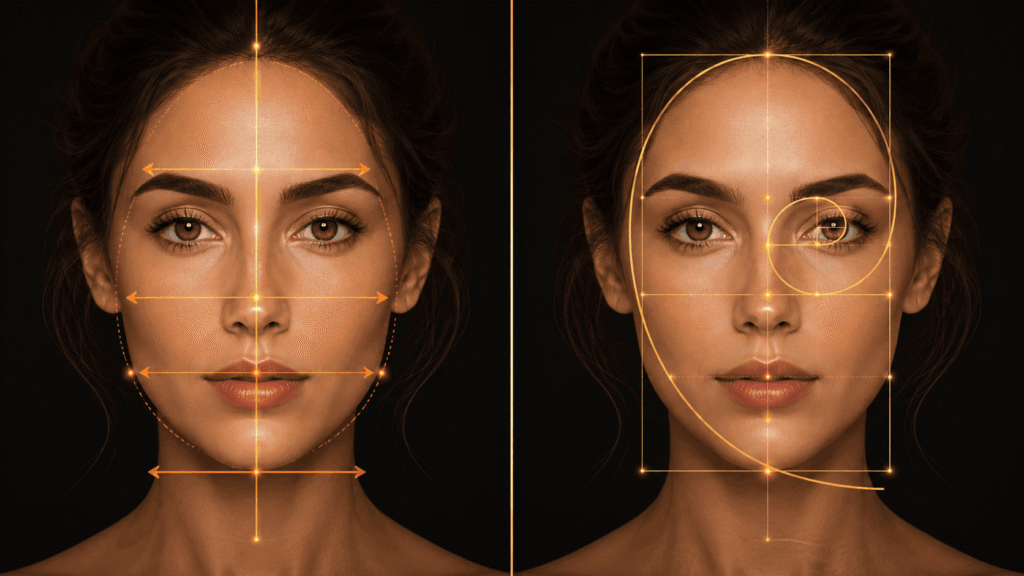
Facial Symmetry vs Golden Ratio — What Is the Difference?
Two frameworks dominate the scientific and popular discussion of facial attractiveness: facial symmetry and the golden ratio. Both are mathematical approaches to measuring facial beauty. Both are supported by research showing correlations with perceived attractiveness. And both are measured by our free face analysis tools.
But they are measuring fundamentally different things, and understanding the difference matters — both for interpreting your analysis results and for understanding what research actually says about facial attractiveness.
This guide explains exactly what each framework measures, what the research says about each, how they relate to each other, and which appears to matter more.
What Facial Symmetry Measures
Facial symmetry measures the left-right balance of your face. It compares paired features — left and right eyes, left and right jaw sides, left and right brows — and quantifies how closely the two halves mirror each other.
A high symmetry score means your facial features are well-balanced between the two sides. A lower score means there are more noticeable differences between your left and right sides.
Facial symmetry is a measure of bilateral balance. It says nothing about whether any individual feature is large, small, close together, or far apart — only whether the left and right versions of each feature match each other.
You can have high symmetry with any face shape, any feature size, and any proportional arrangement of features. Two people with very different facial proportions can both have high symmetry scores. Two people who look similar can have very different symmetry scores.
What the Golden Ratio Measures
The golden ratio — also called Phi or approximately 1.618 — measures facial proportions and their relationship to a mathematical ideal. It is not about left-right balance but about the relationship between different facial measurements.
In facial analysis, the golden ratio is applied to measurements including the ratio of face width to face height, the spacing of the eyes relative to the total face width, the ratio of mouth width to nose width, and the relationship between the upper and lower thirds of the face.
A high golden ratio score means your facial proportions closely approach these mathematical ideals. It is measuring harmony and proportion — whether the relationships between your features approximate the mathematically pleasing ratio of 1.618 that appears throughout nature and art.
Unlike symmetry, the golden ratio score can differ between two people with identical facial shapes if their proportions are different. It can also be high or low regardless of left-right symmetry.
The Key Differences Between the Two
The most fundamental difference is what each is measuring. Symmetry measures left-right balance. The golden ratio measures proportional harmony.
A highly symmetrical face is not necessarily proportionally harmonious. You could have near-perfect left-right balance with proportions that deviate significantly from the golden ratio — a very wide face with even, balanced features, for example.
A face with strong golden ratio proportions is not necessarily symmetrical. The overall proportions of face width to height might closely approach 1.618, while the individual features on each side differ subtly from each other.
In practice, faces that score high on both measures are relatively uncommon, and faces that score high on one but not the other are quite common.
What Research Says About Symmetry and Attractiveness
Facial symmetry has strong, consistent research support as a predictor of attractiveness. Multiple studies using different methodologies — direct symmetry manipulation, natural variation studies, cross-cultural studies — have found that more symmetrical faces are rated as more attractive, healthier, and more dominant.
The evolutionary explanation is that symmetry signals developmental health. Organisms that develop in stable, healthy conditions tend toward greater bilateral symmetry. Environmental stressors — disease, malnutrition, toxin exposure — disrupt the precise bilateral development of paired structures. Observers detecting higher symmetry may therefore be detecting a marker of underlying genetic and developmental quality.
Cross-cultural studies have found that the preference for symmetrical faces appears in populations with no exposure to Western media, suggesting the preference reflects evolved psychology rather than learned cultural standards.
Studies with infants as young as two months have found preferences for more symmetrical faces, indicating the preference develops very early without cultural learning.
However the effect size is moderate — symmetry explains some but not all of the variance in facial attractiveness ratings. Many other factors contribute.
What Research Says About the Golden Ratio and Attractiveness
The golden ratio’s relationship with facial attractiveness has more mixed research support than symmetry, despite its strong popular presence in beauty discussions.
Some studies have found that faces rated as highly attractive do show proportions closer to the golden ratio on specific measurements. A study by psychologists at the University of Toronto found that specific ratios of facial feature distances predicted attractiveness more strongly than overall symmetry in their sample.
However other researchers have found that the relationship between golden ratio proportions and attractiveness is weaker than commonly claimed and may be influenced by which specific measurements are chosen. The golden ratio appears in some facial proportions of attractive faces but is not consistently present across all measurements.
The broader concept of facial proportional harmony — whether features are well-distributed and proportionate relative to each other and the overall face — does appear to contribute to attractiveness independent of symmetry. But the specific value of 1.618 as the ideal may be an oversimplification of a more complex proportional preference.
Which Matters More for Attractiveness?
Based on the research evidence, facial symmetry has stronger and more consistent support as a predictor of attractiveness than the specific golden ratio measurement.
Symmetry preference appears cross-culturally, in infants, and across multiple research methodologies. Its evolutionary basis — signaling developmental health — is well-supported theoretically.
The golden ratio’s relationship with attractiveness is real but weaker and more contested. Proportional harmony clearly matters — faces with very unusual proportions are rated as less attractive — but the specific 1.618 ratio is not as precisely predictive as symmetry.
However the two frameworks are complementary rather than competing. Faces that score high on both — high symmetry and strong golden ratio proportions — are typically rated as the most attractive in research. The combination of balanced features that are also well-proportioned is more attractive than either quality alone.
This is why our AI Face Analyzer measures both symmetry and golden ratio as separate components of the overall beauty score — because each captures a different dimension of facial harmony that the other misses.
How Other Factors Compare to Both
Both symmetry and the golden ratio, while important, explain only a portion of what makes a face perceived as attractive. Several other factors have been found to matter as much or more in different research contexts.
Skin quality and apparent health are major attractiveness factors. Clear, even-toned, well-hydrated skin is strongly associated with perceived attractiveness across cultures — and this effect is independent of both symmetry and golden ratio proportions. A face with moderate symmetry and good skin often outperforms a more symmetrical face with poor skin in attractiveness ratings.
Facial averageness is a counterintuitive but robust finding. Faces that are statistically average for their population — composite faces created by digitally averaging many faces — are consistently rated as more attractive than individual faces, including highly symmetrical ones. Averageness reflects that no single feature deviates dramatically from the norm.
Sexual dimorphism — the degree to which a face shows distinctively masculine or feminine features — affects attractiveness independently of symmetry and proportion. Strongly feminine facial features in women and strongly masculine jaw and brow structure in men are both associated with higher attractiveness ratings.
Expression and personality perception affect attractiveness ratings significantly in real-world contexts. A warm, genuine smile dramatically increases perceived attractiveness in ways that symmetry scores cannot capture.
Using Both Frameworks Together
The most comprehensive approach to facial analysis uses both symmetry and proportional harmony together, which is exactly what our tools do.
Our Face Symmetry Analyzer focuses specifically on the left-right balance measurement, giving you a detailed breakdown of symmetry in each facial feature area.
Our Beauty Calculator focuses on golden ratio proportional analysis, measuring how closely your facial proportions approach the mathematical ideal.
Our AI Face Analyzer combines both frameworks — along with eye symmetry, lip proportions, and feature balance — into a single comprehensive beauty score out of 100.
Using all three together gives you the most complete picture of your facial harmony from both a symmetry and a proportional perspective.
Frequently Asked Questions About Facial Symmetry vs Golden Ratio
What is the difference between facial symmetry and the golden ratio?
Facial symmetry measures left-right balance — how closely the two halves of your face mirror each other. The golden ratio measures proportional harmony — how closely the relationships between your facial measurements approach the mathematical ratio of 1.618. They measure different things and a face can score high on one but not the other.
Which is more important for attractiveness — symmetry or golden ratio?
Research supports facial symmetry as the more consistent and cross-culturally robust predictor of attractiveness. The golden ratio relationship with attractiveness is real but more contested in the research literature. Both contribute to facial harmony and the most attractive faces tend to score well on both measures.
Can you have good symmetry but poor golden ratio proportions?
Yes. Symmetry and golden ratio proportions are different measurements. You could have near-perfect left-right balance with proportions that deviate from the golden ratio, or strong golden ratio proportions with noticeable asymmetry between the two sides.
What does a golden ratio face look like?
A face with strong golden ratio proportions has a face width to height ratio approaching 1.618, eye spacing that is approximately one-fifth of total face width, and other feature relationships that approach this mathematical ratio. These proportions create a sense of balanced harmony that many observers find naturally pleasing.
How do I test both my symmetry and golden ratio?
Use our free Face Symmetry Analyzer for a detailed symmetry score, our Beauty Calculator for golden ratio proportions, or our AI Face Analyzer for a combined score that includes both frameworks alongside other metrics.
Related Guides and Free Tools
Face Symmetry Analyzer measures your left-right facial balance with a detailed AI symmetry score.
What Is Facial Symmetry explains the science, causes, and measurement of facial symmetry in detail.
Beauty Calculator calculates your golden ratio facial harmony score from a photo.
AI Face Analyzer combines symmetry, golden ratio, and other metrics into a comprehensive beauty score out of 100.
Face Shape Detector identifies your face shape with personalized style recommendations.