
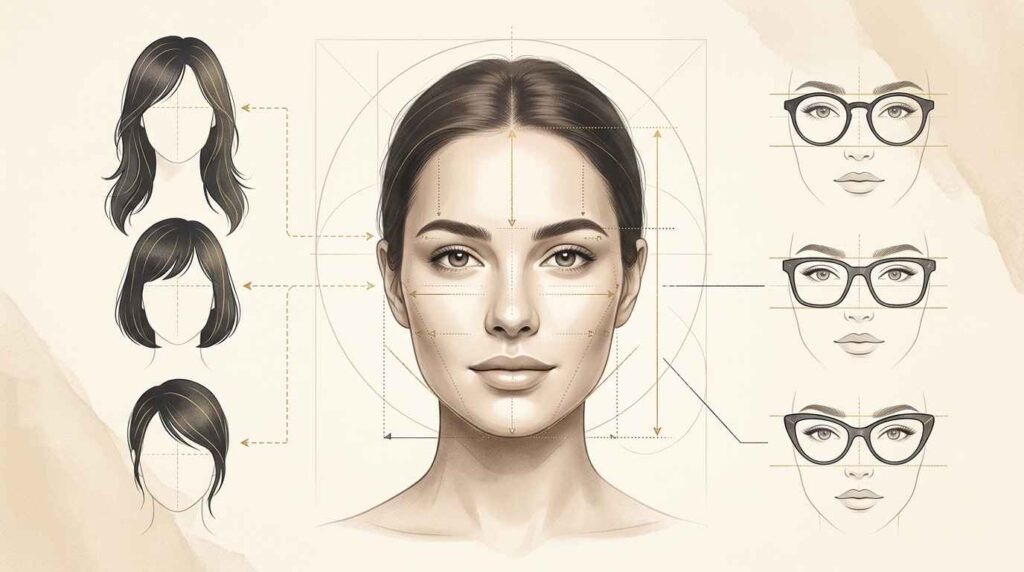
Hair and glasses both edit your outline. Add width or height where your face has least, and don’t repeat your strongest dimension.
Facial proportions are the measured relationships between your face length, forehead, cheekbones and jaw. They decide how hairstyles and eyeglasses balance your face shape.
Muhammad Rehan Iqbal is the Founder and Developer of OvalFaceShape.com. He specializes in face shape analysis, interactive facial assessment tools, and educational styling guides, combining web development, SEO and facial-analysis expertise.
Who This Guide Is For:
This guide is for glasses wearers choosing a haircut, or new frames, from their own measurements instead of a generic list.
- Full-time glasses wearers booking a haircut
- Anyone replacing frames and hair in the same season
- People whose “right” haircut and “right” frames still look off together
The Four Proportions Behind Both Decisions
Four measurements drive nearly every recommendation here:
- Length-to-width ratio: face length divided by cheekbone width.
- Forehead vs. jaw width: which is wider, and by how much.
- Widest point: forehead, cheekbones or jaw.
- Jaw shape: curved or angular.
These definitions follow the anthropometric landmarks documented by Leslie G. Farkas in Anthropometry of the Head and Face (1994). Farkas defined the measurements. The styling rules built on them are conventions of balance, not scientific laws.
To get your numbers, use the Face Shape Detector for a photo or the Face Shape Calculator for tape measurements.
One Principle: Add What Your Proportions Lack
Hairstyle and glasses advice looks complicated only because it’s printed as two lists. Both follow one rule: add visual weight where your face has least, and avoid repeating your strongest dimension.
| Your pattern | What it needs | Hair does | Glasses do |
| Long (ratio above ~1.5) | Width | Side volume, bob | Wide frames, shallow lenses |
| Short and wide | Length | Crown height, long layers | Narrower, angular frames |
| Wide forehead, narrow jaw | Weight low | Chin-level volume | Light tops, bottom-heavy or rimless |
| Wide jaw, narrow forehead | Weight high | Fringe, volume at the crown | Browline, cat-eye |
Neither hair nor glasses changes your measurements. They change which proportion the eye notices first.
Hairstyles by Proportion, Not by Label
Face shape labels are shortcuts for proportion patterns, so work from the pattern.
| Dominant proportion | Goal | Styles that do it |
| Length well above width (oblong) | Add width | Chin-length bob, side fringe, waves |
| Length near width, curved jaw (round) | Add height and angles | Long layers, crown height, side bangs |
| Similar widths, angular jaw (square) | Soften corners | Soft layers, waves, side parts |
| Forehead wider than jaw (heart) | Add fullness at chin level | Chin-length bob, jaw layers |
| Cheekbones widest (diamond) | Add width at forehead and chin | Fringe, low volume behind the ears |
Where the volume sits matters more than hair length. A long style with side width can suit a long face better than a short style with crown height.
Glasses by the Same Four Proportions
Glasses follow the same proportions, but frames are hard-edged and sit at eye level, so their angles read more strongly than hair. Three checks cover most decisions.
- Width: frames should sit close to your face width at the temples. Much narrower frames make the face look wider.
- Depth: tall lenses add visual length. A short face can use that; a long face usually can’t.
- Shape: contrast the jaw. Angular frames define a soft face, and rounded frames soften an angular jaw.
Your forehead-to-jaw proportion decides where frame weight goes. A wide forehead and narrow chin suit lighter tops or rimless styles. A narrow forehead and wide jaw suit browline or cat-eye frames.
See the Oval Face Shape and Round Face Shape guides for per-shape detail.
When Your Hairstyle and Glasses Work Against Each Other
Hair and glasses spend the same balance budget. Two choices that are each right can still cancel out.
- Heavy fringe + thick browline: doubles the weight on the forehead band. On a heart or inverted-triangle pattern, that’s the band that needs it least.
- Crown height + tall frames: adds length twice, which is a problem on a long face.
- Pixie cut + bold frames: the frames carry the whole look. That’s good if you want statement frames, and a trap if you want them to disappear.
The fix is to keep both items and change one. Pair the fringe with thin or rimless tops, or keep the browline and sweep the fringe sideways.
Hairstyles That Work With Glasses, Shape by Shape
Two clearance details apply to every cut: the fringe should end above the top rim or sweep clear of it, and layers shouldn’t trap the temple arms.
| Face shape | Hairstyle | Frame pairing |
| Oval | Almost any cut; lobs and long layers | Most frames; rectangles add definition |
| Round | Long layers, lob, side fringe above the frame line | Rectangular or angular |
| Square | Soft waves, jaw-skimming layers, side part | Round or oval |
| Heart | Chin-length bob, side fringe | Light, rimless or bottom-heavy |
| Oblong | Bob or waves with side volume, fringe | Wide frames, wider than tall |
These cuts share one trait: the movement sits below or beside the frames, not behind them. That’s why bobs, lobs, long layers and side fringes recur in every list for glasses wearers. The Oblong Face Shape guide covers the longest pattern in detail.
Common Mistakes
- Choosing the haircut and frames in separate appointments
- Judging a cut without your glasses on
- Using the 2.25 rule as the only measurement
- Copying a celebrity’s frames onto a different proportion pattern
- Matching frame shape to face shape instead of contrasting it
Salon and Optician Checklist
- Bring your four measurements, or a screenshot of your Face Shape Detector result.
- Wear your glasses to the salon and judge the cut with them on.
- Try frames with your hair styled the way you wear it daily.
- Check that fringe clears the top rim and layers clear the arms.
Key Takeaways
- Hair and glasses edit the same outline. Choose them together, not separately.
- Add what your proportions lack, and don’t repeat your dominant dimension.
- Volume below or beside the frames suits the widest range of glasses wearers.
- Shortcuts like the 2.25 rule estimate one proportion. The four measurements give the fuller picture.
FAQs
Do glasses affect your face shape?
No. Your forehead, cheekbone and jaw widths are the same with frames on or off. Glasses change which proportions the eye notices, not the shape itself.
What is the 2.25 rule?
It’s a short-hair shortcut credited to stylist John Frieda. Hold a pencil under your chin and a ruler under your earlobe. If the earlobe-to-pencil distance is 2.25 inches (5.7 cm) or less, short hair will likely suit you. It’s a stylist’s heuristic that estimates one proportion only.
What is the most attractive face ratio?
No single ratio has been established. A 3D stereophotogrammetry study by Rossetti and colleagues found most measured ratios deviated from the golden ratio (1.618), and an association with attractiveness couldn’t be established. Averageness, symmetry, skin and expression also play a part.
Do longer faces look better with short or long hair?
Neither by default. What matters is where the volume sits. A bob, side-volume waves or a fringe balance a long face. Crown height adds more length.
Should glasses contrast with your face shape or match it?
Contrast, in most cases. Angular frames define a soft face, and rounded frames soften an angular jaw. Matching repeats the dominant trait. The exception is deliberate: if you want to emphasize a strong jaw, angular frames are a choice.
How do I choose a hairstyle if I wear glasses all day?
Treat the frames as fixed and choose hair around them. If you’re replacing both, pick frames first, since they sit at eye level. Then check fringe clearance, temple-arm clearance, and that volume sits below or beside the frames.
Is face-shape styling still worth using?
Yes, as a proportion framework, not rigid rules. The measurements haven’t changed, and detectors make them quick to take from a photo. Use the framework to narrow your options. Texture and preference settle the close calls.
Find Your Proportions Before You Choose
Everything above runs on four numbers, and guessing them from a mirror is where most decisions go wrong. Run the Face Shape Detector to get your ratio and your forehead, cheekbone and jaw widths, then take the table rows that match your pattern to the salon or the optician.